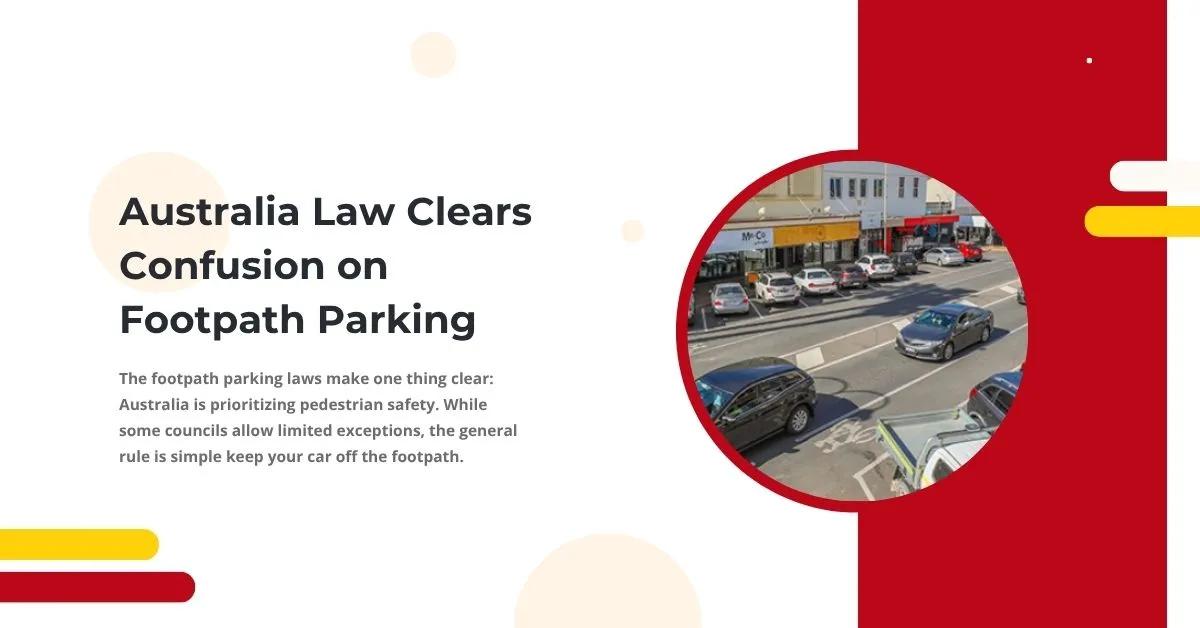
Imagine returning to your car only to find a hefty fine tucked under your wiper all because you parked with two wheels on the footpath to “leave more room.” This frustrating scenario is becoming increasingly common across Australia as authorities crack down on footpath parking. With confusing state-by-state differences and new regulations now in effect, what you don’t know can definitely cost you.
The core rule is simple: parking on a footpath or nature strip is illegal nationwide, designed to protect pedestrians, children, and people with disabilities. However, the devil is in the details. Fines vary significantly, ranging from approximately $180 in Queensland to $275 in New South Wales, and limited local council exceptions do exist.
This guide cuts through the confusion, providing a clear breakdown of the updated laws, penalties, and the critical safety reasons behind them. Knowing these rules isn’t just about avoiding a fine it’s about ensuring our streets are safe for everyone.
Nationwide Rule: Footpath Parking is Largely Illegal
The fundamental rule across Australia is that parking on a footpath or nature strip is illegal. The primary reason is safety; these spaces are designated for pedestrians, including children, the elderly, individuals with prams, and people with disabilities. When vehicles block these paths, pedestrians are forced onto the road, significantly increasing the risk of accidents.
While the rule is consistent in its intent, limited exceptions exist in certain states, always dependent on specific local council signage.
2025 Law Updates and Stricter Enforcement
The 2025 traffic law updates have brought stricter enforcement and increased fines for footpath parking violations. This is part of the national “Safe Streets Initiative” aimed at protecting pedestrian spaces.
- Increased Fines: Penalties now range from approximately $160 to $600, depending on the state or territory.
- Enhanced Surveillance: Councils are increasingly using surveillance cameras to automatically detect vehicles illegally parked on footpaths and nature strips.
State-by-State Breakdown of Fines and Exceptions
While the core rule is the same, fines and specific exceptions vary. The table below outlines the key differences:
| State/Territory | Fine for Footpath Parking (Approx.) | Legal Exceptions | Governing Authority |
|---|---|---|---|
| Victoria | $192 | Only where specific council signs permit | VicRoads / Local Council |
| New South Wales | $275 | No exceptions; strictly prohibited | Transport for NSW |
| Queensland | $180 | Only in narrow streets with explicit signage | QLD Police / Local Council |
| Western Australia | $200 | Authorised zones only, as per council signage | WA Road Safety Commission |
| South Australia | $183 | No exceptions; strictly prohibited | SA Police / DIT |
| Australian Capital Territory | High Penalty | No exceptions; strictly enforced | Access Canberra |
Legal Parking Guidelines and Pedestrian Safety
The core objective of these laws is to ensure pedestrian safety. Drivers are reminded to always:
- Park parallel to the curb and within marked lines.
- Avoid parking across driveways, pedestrian crossings, and in school zones.
- Look for and obey all parking signage, even in residential areas.
Authorities encourage the public to report illegal parking via local council apps like “Snap, Send, Solve” to help keep footpaths clear and safe for everyone.
Conclusion
Staying on the right side of Australia’s footpath parking laws is straightforward when you understand the fundamental principle: footpaths are for people, not cars. While limited, signposted exceptions may exist, the safest and most lawful practice is to always keep all four wheels off the footpath and nature strip. By parking legally and responsibly, you contribute to safer communities, avoid substantial fines, and ensure that pedestrian pathways remain clear and accessible for all who need them.
Frequently Asked Questions
-
Is it ever legal to park on a footpath in Australia?
Generally, no. It is illegal across Australia. The only exceptions are in very specific areas where a local council has erected a sign explicitly authorizing footpath parking, often in narrow streets. If there’s no sign, it’s illegal
-
Can I park on the footpath outside my own house if the street is narrow?
No. The law applies equally regardless of where you live. Parking on the footpath outside your own home without specific council authorization is illegal and can result in a fine.
-
Are the rules the same in every Australian state and territory?
The overarching rule that footpath parking is prohibited is consistent. However, the fines differ between states, and the application of limited exceptions (e.g., for narrow streets) is determined by local councils and can vary. Always look for and obey local signage.