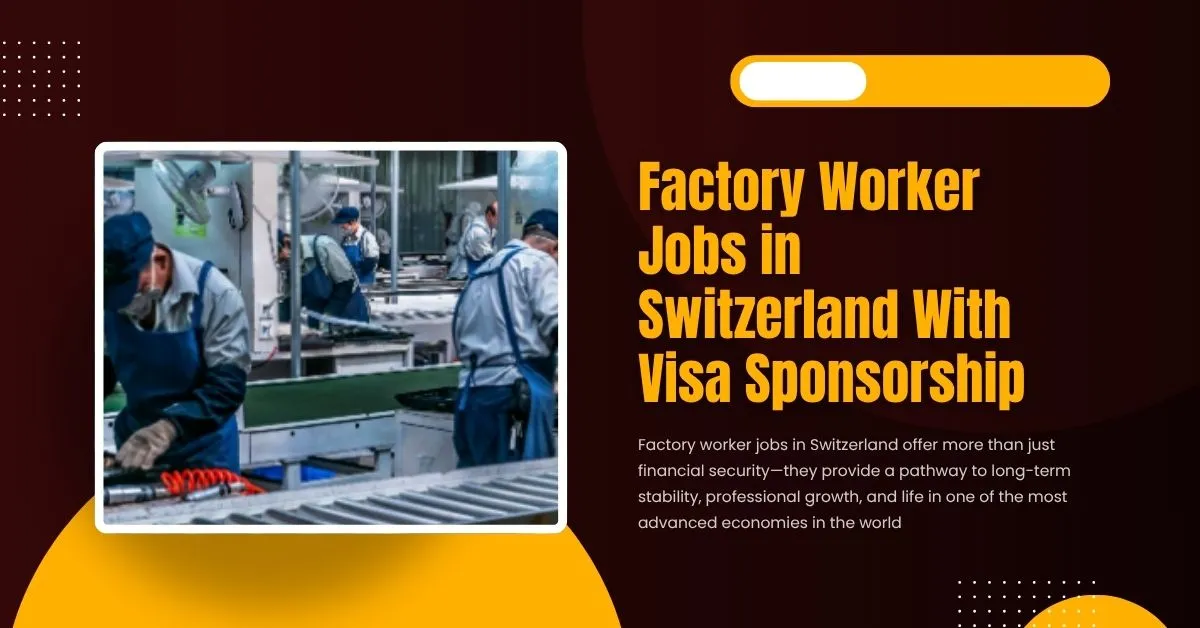
Imagine building a stable, high-earning career in the heart of Europe, surrounded by breathtaking landscapes and working within world-renowned industries. Switzerland’s manufacturing sector, the engine of its economy, is actively seeking dedicated factory workers to uphold its legendary standards of quality in watchmaking, pharmaceuticals, and engineering. For skilled and reliable individuals from abroad, this is a rare opportunity to secure a world-class salary and a life in one of the planet’s most prosperous and safe countries.
To qualify for these sought-after roles, you will typically need a basic education, good physical fitness, and strong attention to detail. Prior experience in manufacturing is a significant advantage. In return, you will be rewarded with a high annual salary ranging from CHF 50,000 to CHF 70,000, along with exceptional benefits including full visa sponsorship, comprehensive health insurance, and pension plans. If you are diligent, precise, and ready for a rewarding challenge, your future on a Swiss production line awaits.
Why There is Demand for Factory Workers in Switzerland?
Switzerland’s reputation for excellence is built on a foundation of advanced manufacturing. Factory workers are the backbone of this sector, ensuring the precise and efficient production of world-renowned goods, from luxury watches and pharmaceuticals to specialty foods and high-tech machinery. The sustained demand for these roles is driven by a unique combination of economic strength and demographic challenges.
Key Drivers of Demand:
- A Robust and Diversified Manufacturing Base: Switzerland’s industrial sector is a pillar of its economy, contributing significantly to GDP. It’s not a single industry but a diverse ecosystem including:
- Precision Engineering & Watchmaking: The famed “Swiss Made” label demands meticulous assembly and quality control.
- Pharmaceuticals & Chemicals: Global giants like Roche and Novartis require workers for production, packaging, and logistics in sterile, high-tech environments.
- Food Production: Companies like Nestlé and Lindt rely on factory workers for the manufacturing of globally consumed products, emphasizing hygiene and consistency.
- Medical Technology & Machinery: This high-value sector requires workers skilled in operating advanced computerized equipment.
- A Deep-Seated Labor Shortage: Switzerland faces a structural shortage of workers for vocational and physically demanding roles. With low domestic unemployment, Swiss companies have a long history of looking abroad to fill these essential positions, creating opportunities for foreign nationals.
- An Uncompromising Commitment to Quality: The “Swiss Made” standard is a globally recognized mark of quality and precision. This reputation can only be maintained by a skilled and reliable workforce capable of executing complex production tasks with extreme attention to detail.
- Demographic Shifts and an Aging Workforce: As a significant portion of the skilled Swiss workforce reaches retirement age, a generational gap is emerging. This creates a continuous need to recruit and train new workers to sustain production levels and preserve institutional knowledge.
- Economic Stability and Export Orientation: Switzerland’s political and economic stability makes it an attractive hub for manufacturing. As a major exporter, its factories must run efficiently to meet international demand, further fueling the need for a steady and capable workforce.
Check Also: Truck Driver Jobs In Switzerland with Visa Sponsorship
Salary Expectations for Factory Workers in Switzerland:
Salaries for factory workers in Switzerland are highly competitive, reflecting the country’s high cost of living and strong labor laws. Wages vary significantly by industry, region (with higher pay in Zurich or Geneva), and specialization.
- Entry-Level Positions: Workers with little to no experience can expect starting salaries ranging from CHF 50,000 to CHF 58,000 per year. These roles typically include comprehensive on-the-job training.
- Experienced and Specialized Workers: Those with several years of experience, vocational training (EFZ), or skills in operating complex machinery (e.g., CNC) can earn between CHF 60,000 and CHF 75,000 annually. Roles with team leadership or quality assurance responsibilities command the higher end of this range.
Additional Benefits:
Swiss employment packages are renowned for their generosity. Beyond the salary, benefits often include:
- A mandatory pension fund contribution (BVG/LPP)
- Comprehensive health insurance plans (often subsidized)
- At least four weeks of paid vacation
- Overtime pay and shift allowances (common in 24/7 production)
- Year-end bonuses (“13th-month salary”)
- Company-specific perks like subsidized meals, public transport passes, and professional training opportunities.
Job Responsibilities of a Factory Worker in Switzerland:
The role is dynamic and goes beyond simple manual labor, especially in high-tech environments.
- Operating and Monitoring Machinery: Setting up, operating, and troubleshooting specialized production equipment and automated systems.
- Precision Assembly and Production: Performing intricate assembly work, particularly in watchmaking, medtech, and electronics, where steady hands and focus are critical.
- Rigorous Quality Control: Continuously inspecting products at various stages of production to ensure they meet strict specifications, documenting any deviations.
- Packaging and Logistics: Preparing finished goods for shipment according to specific standards, which includes labeling, palletizing, and operating warehouse management systems.
- Adherence to Safety and Cleanliness: Following stringent health, safety, and environmental (HSE) protocols, especially in food and pharmaceutical production (GMP standards).
- Maintenance and Lean Manufacturing: Performing basic machine maintenance (cleaning, lubricating) and participating in continuous improvement (Kaizen) initiatives to enhance efficiency.
Requirements for Factory Worker Jobs in Switzerland for Foreigners:
While some roles are entry-level, Swiss employers have high standards for reliability and aptitude.
- Education and Training: A compulsory school diploma is a minimum. A Federal VET Diploma (EFZ) in a field like polymechanics, production mechanics, or logistics is a significant advantage and can lead to higher pay.
- Physical Stamina and Dexterity: The job requires standing for long periods, lifting moderate weights, and performing repetitive tasks with precision.
- Strong Attention to Detail: A meticulous approach is non-negotiable for maintaining the quality synonymous with Swiss manufacturing.
- Technical Aptitude and Experience: Prior experience in a industrial setting is highly valued. Basic understanding of mechanical processes or experience with machinery is a strong plus.
- Language Skills: Proficiency in the local language (German, French, or Italian, depending on the canton) is often required for safety and team integration. English may be sufficient in some international companies, but learning the local language is key for long-term success.
- Work Permit Eligibility:
- EU/EFTA Citizens: Benefit from the Agreement on the Free Movement of Persons, making the process relatively straightforward.
- Non-EU/EFTA Citizens: Face a quota system for B and L permits. Employers must prove the role cannot be filled by a Swiss or EU/EFTA national. This is more feasible for skilled workers with specialized experience or vocational qualifications.
Benefits of Factory Worker Jobs in Switzerland:
- Strong social protections
Employees receive health insurance, accident insurance, old-age pension, unemployment insurance, etc. Swiss labor law ensures safety, fair working hours, overtime pay, etc. - Paid leave and holidays
Minimum holidays, paid days off, and sick leave. Swiss law protects these rights. - Career growth & training opportunities
Some factories offer on-the-job training and advancement to skilled technician or supervisor roles. Language and technical training may be supported - Access to high quality of life
Good infrastructure, public services, legal protections, clean environment, and stability. Wages offset high living cost for many. - Possibility for longer permits and family reunification (in some cases)
If the employment is longer term and permit type allows, bringing dependents might be possible. Also stable contracts help in renewal of permits.
Visa/Work Permit Requirements:
Who this applies to:
- Mainly non-EU/EFTA nationals who need employer sponsorship and government permit. EU/EFTA nationals have easier access under free movement agreements.
Key Requirements / Steps:
- Job offer & employer sponsorship
You must have a job offer from a Swiss employer who is willing to sponsor your work permit. The employer must be legally registered in Switzerland. - Labour market test / proving scarcity
For non-EU/EFTA nationals, the employer often must prove that no suitable Swiss / EU/EFTA candidate was found for the position. This is part of the admission criteria. - Quotas / permit limits
Work permits for third-country nationals are limited by quotas. Cantons and federal authorities allocate a limited number of permits. So even if you qualify, there may not always be a permit available - Permit type depending on contract
- L-permit: for shorter‐term employment, often less than 1 year.
- B-permit: longer‐term contract, renewable annually or per canton’s rules
- Other permits (C permit or permanent) for long-term residents
- Qualifications / experience
Even for factory roles, relevant work experience or training helps. Basic education is often sufficient, but specialized or technical roles require skills or credentials. Knowledge of local language(s) (German, French, Italian) may improve chances. - Salary / contract conditions
The employment contract must respect Swiss labor standards: pay at least the minimum or collective agreement wage in that sector, define hours of work, overtime, rest days, etc. The salary must be enough to support you given high cost of living - Valid passport, identity documents, clean record
Passport valid for required duration, sometimes criminal background check, proof of ability to integrate, etc - Health insurance & social security coverage
Must arrange or be part of Swiss health insurance; employer contributes to social security. Accident insurance, pensions etc. are mandatory - Registration in Switzerland & obtaining residence permit
Once you arrive, you will need to register with the local authorities (communal office), supply your residence/work permit - Language and integration (optional but helpful)
While not always strictly required, having local language skills (German/French/Italian depending on canton) helps in daily life, workplace communication, and may increase the chance of permit approval.
How to Apply for Factory Worker Jobs in Switzerland With Visa Sponsorship?
A strategic and professional approach is essential for international candidates.
- Target Major Employers and Regions: Research large companies like Nestlé, Novartis, Roche, Swatch Group, Richemont, and Lindt & Sprüngli. Focus on industrial cantons like Zurich, Aargau, Basel-Landschaft, Vaud, and Neuchâtel.
- Utilize Swiss Job Portals: Use platforms like JobUp.ch, Indeed.ch, and LinkedIn. For non-EU candidates, look for posts explicitly stating “work permit assistance” or “international candidates welcome.”
- Partner with Specialized Recruitment Agencies: Agencies like Michael Page, Adecco, and Manpower have strong industrial divisions and understand the visa sponsorship landscape.
- Prepare a Swiss-Standard CV: Create a clean, concise CV (one to two pages) with a professional photo. Clearly list your technical skills, machinery proficiencies, and language abilities. A well-crafted, tailored cover letter in the correct language is crucial.
- Understand the Permit Process: Once you have a job offer, your employer will initiate the work permit application with the cantonal immigration authorities. You will need to provide documents such as your passport, signed employment contract, and educational diplomas.
Conclusion:
Factory worker roles in Switzerland offer an unparalleled opportunity for international job seekers to access a high-wage economy and an exceptional quality of life. While the requirements for precision and the initial visa process can be demanding, the rewards financial stability, career development, and the chance to live in a stunning, safe country are immense. By highlighting your technical skills, reliability, and willingness to adapt, you can position yourself as a valuable candidate to Swiss employers and take a decisive step toward a prosperous future in the heart of Europe.
Frequently Asked Questions:
-
Is it difficult for a non-EU citizen to get a work permit?
It can be challenging, as employers must prove they cannot find a Swiss or EU citizen for the role. However, for skilled and experienced factory workers, especially in high-demand sectors, employers are often willing to sponsor the permit. Demonstrating specialized skills greatly improves your chances.
-
What is the average salary for a factory worker in Switzerland?
Salaries are among the highest in Europe, ranging from CHF 50,000 to CHF 70,000 per year. Entry-level positions start around CHF 50,000, while experienced workers with specialized skills can earn up to CHF 70,000.